

The Blaenserchan Project, whose methodology is concerned with the post-industrial landscape not as a resolved or restored environment, but as an ongoing ecological and social process

Overview
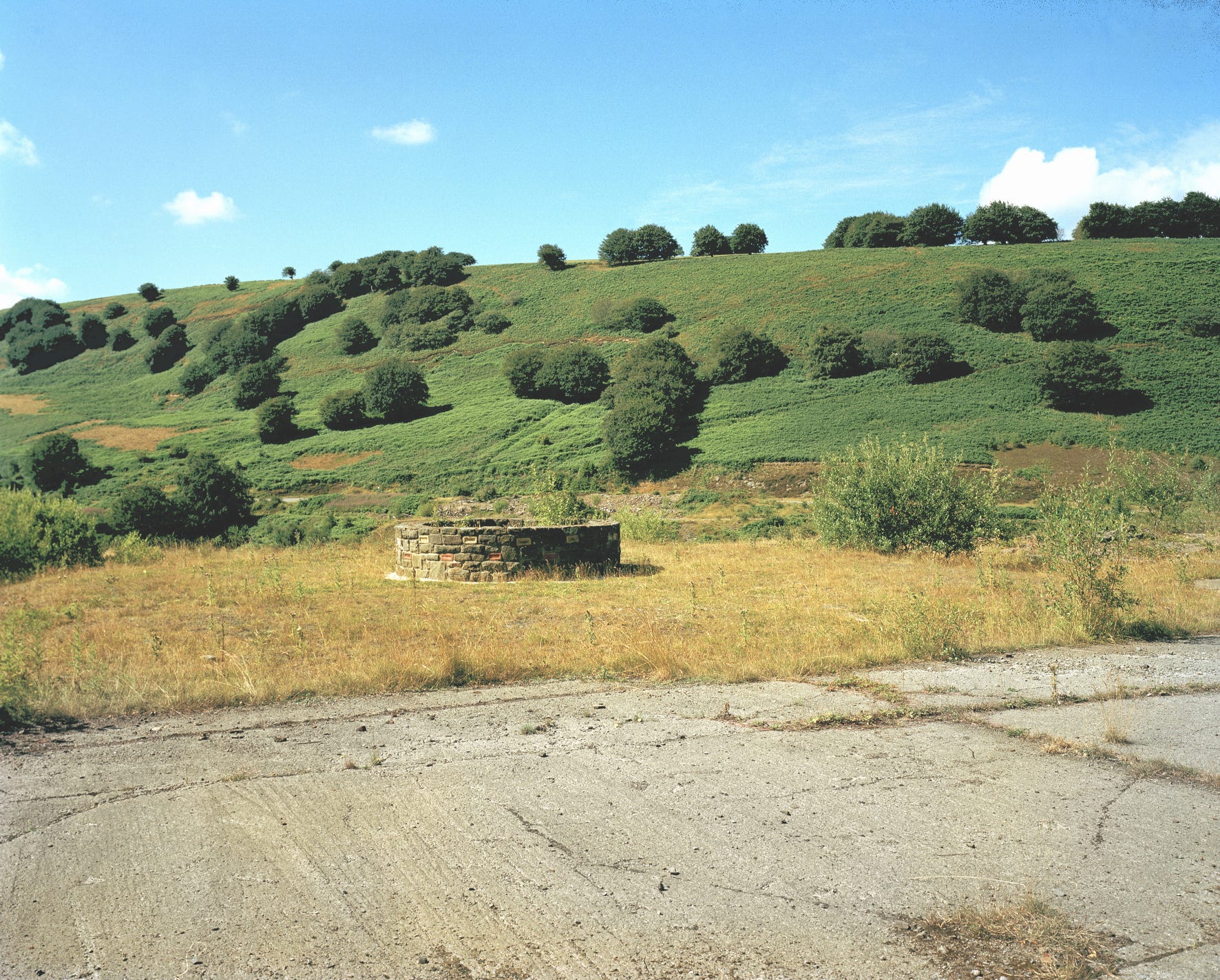
The Blaenserchan Project is a long-term, interdisciplinary art and research initiative examining Blaenserchan Colliery and the surrounding Cwm Ddu Valley (including its wider spatial and temporal terrain) as a contested landscape shaped by the intersecting forces of nature and history. Centred on the material and symbolic legacy of industrial production and extraction, the project situates the location within a longer trajectory of environmental transformation, linking local histories of work, community, resource exploitation and nature to the wider conditions that have culminated in the contemporary crises.
The research unfolds as an eight-year diaristic inquiry, combining historical, aesthetic and speculative modes of investigation culminating in the 50th anniversary of the 1984–85 miners’ strike.
Through this sustained engagement, the project approaches the post-industrial landscape not as a resolved or restored environment, but as an ongoing ecological and social process, one that invites critical reflection on how historical forms of production as extraction – extraction, here, in the universal sense of the capitalist production of surplus (monetary) value from nature, the subject and the community – continue to inform present social and ecological precarity. And how such recognition might contribute to critically informed and imaginative relations to landscape in the future.
Methodological Framework
The principal task of this research is to understand Blaenserchan Colliery and the Cwm Ddu Valley beyond their inscription as a static historical site or, more commonly, as a spiritualised or nostalgic landscape. While these kinds of framing remain culturally powerful, particularly within local memory and post-industrial identity, they risk obscuring the material, political and ecological forces that continue to shape the landscape today.
The project therefore proceeds through a dual ‘methodological’ orientation:
• Analytical–material: the landscape is approached as a landscape of capital, a product of industrialisation, labour and surplus-value extraction, whose effects persist in both human and non-human life.
• Figurative–speculative: the landscape is also treated as an emblematic site capable of mediating access to what is outside itself: to that which remains unresolved or obscured within the historical record, the present ecological and post-industrial condition and possible futures locally, nationally and globally.
This dual approach resists treating the landscape as either inert ruin or redeemed nature, neither as a localised or particular condition. Instead, it frames the Blaenserchan location and Cwm Ddu valley as an active, contested site where histories of, say, production, labour and environmental degradation, intersect with contemporary (more universal) questions. For instance, climate breakdown, private-public land use, ecological responsibility, social and economic precarity and current debates within political economy.
Theory into praxis models: Cognitive Mapping, Constellation, Negative Dialectics, Dialectical Image, Art’s Autonomy
The methodological framework draws upon critical theory and aesthetic philosophy, particularly the work of Walter Benjamin, Theodor W. Adorno and Fredric Jameson, all of whom insist that aesthetic practices are capable of producing rational knowledge and not only affects. Loosely organised as follows:
• Jameson’s concept of cognitive mapping provides a political and methodological momentum to how figurative and aesthetic forms might render perceptible the abstract, global operations of capitalism as they are lived locally and experientially. For Jameson, recognition is a prerequisite for political change, that representation, particularly that kind which connects the everyday to the objective reality of capital, allows us to ‘see’ that which has until now remained hidden.
• Benjamin’s concept of the ‘constellation’ offers a non-linear mode of historical understanding, in which disparate material, historical and affective elements are brought into dialectical relation. Knowledge emerges not through synthesis, but through tension: knowledge as revelation, fundamental to his dialectical image organon.
• Adorno’s negative dialectics, particularly as developed in the essay form as constellation, refines this approach into a method that resists closure, identity thinking (fitting knowledge into a conventional and static closed box) and instrumental rationality. Truth, for Adorno, appears not in totality, but in the refusal of any false reconciliation with the object or concept.
• Adorno’s ostensible autonomy of art, which constitutes a defining feature of what he termed ‘great art’: a form of artistic practice that brings us to remember our real nature by detaching us from the domain of instrumental reason. Within Adorno’s dialectical framework, art is paradoxically rational precisely because of its apparent irrationality. Set against society’s dogmatic and administered rationalism, art exposes this as deeply irrational, because it works against the true interests and nature of the subject. Nevertheless, this project relies more cautiously on the notion of semi-autonomy, while still drawing upon Adorno’s conceptualisation. Conceived as autonomous in this qualified sense, the artwork resists becoming spectacle, entertainment, or a mere mirror of capitalist ideology. Unlike Adorno’s full autonomy of the artwork, it does not claim full separation from the world it inhabits. Its (semi-) autonomy lies in the refusal to be ‘predigested’ or subordinated to the languages of profit, spectacle, or consumption.
Taking certain philosophical liberties, the project mediates between Benjamin’s speculative–theological model of the constellation and Adorno’s secularised, critical adaptation and along with his theory of autonomy. In doing this, it can be seen to align with Benjamin’s notion of ‘crude theory’, or the remodelling of theory appropriate for praxis (yet, still, acknowledging the philosophical / theoretical complexity from which it was originally derived).
Epistemological Pluralism
The project operates through a pluralistic methodology, combining rational analysis with imaginative, speculative and potentially redemptive modes of engagement. In this sense, aesthetic practice becomes an instrument capable of:
• forging connections across heterogeneous forms of knowledge,
• resisting the reduction of nature and subjectivity to resource or data,
• and reintroducing imaginative and experiential dimensions that are often excluded from ecological, geographical, historical, economic and sociological research, for example. At the same time recoginsing their value to the project.
Landscape as Dialectical Site and Climate Prism
The Blaenserchan landscape is approached as a dialectical location, a Benjaminian monad, or microcosm, through which the dynamics of history, global capitalism, ecological degradation and social precarity can be read in condensed form.
Although now designated a nature reserve, the apparent restoration of the valley should not be mistaken for ecological innocence. Such landscapes often function as:
• repositories of unresolved industrial damage,
• pretexts for new forms of commodification (leisure, tourism, carbon offsetting, for example),
• or managed environments shaped by economic imperatives rather than ecological or social justice.
• As ciphers for public and private debates concerning land use, access and development.
• An alibi that distracts attention from the climate emergency and the continued domination and destruction of nature.
In Benjamin’s redemptive hermeneutic, they provide not only warnings from history, but access to an alternative form of social organisation, closer to that other side of human nature: the collective. What is being proposed here, is something mimetic – to borrow from Adorno. The project insists that what capital has done to this landscape, to nature, through production, extraction, exhaustion and abandonment, prefigures the broader (social and environmental) dynamics of the climate emergency. And, following Marx’s insight, that the domination of nature mirrors the domination of the subject. The climate crisis is thus not external to social relations, but an intensification of them – hastening the need for a more mimetic relation to nature. The essential criteria of which underscores what has become known as ‘eco-socialism’ after Joel Kovel’s original conception.
By situating the Blaenserchan landscape within this framework, the project reads the post-industrial landscape not as an exception, but as precursor. An instance in an ongoing catastrophe (of human production), today characterised by environmental and climate degradation, social precarity and inequality.
Subjectivity, Memory and Critical Remembering
Central to the project is the question of how to make the subject – experience –present without resorting to romanticisation. The subject that should emerge, here, would not be a heroic or nostalgic one, but one shaped by economic necessity, political power and material conditions – that would include moments of resistance. The project is, then, concerned with
• how suppressed histories continue to structure social and ecological realities,
• how landscapes remember exploitation even when it is visually obscured,
• and how critical remembering might contribute to imagining more just futures.
In unison with Benjamin’s insistence on the redeemability of the past, the project treats historical inquiry as an intervention into the present, not an act of commemoration alone, but a form of active political critique.
Art Objects as Heuristic Devices
Within this methodological framework, the art object becomes essential. Its speculative and imaginative capacity allows it to operate beyond fixed or purely rational modes of knowledge. Rather than delivering predetermined meanings, it opens a poetic space in which multiple interpretations can coexist.
Artworks function heuristically:
• as keys that unlock unexpected connections,
• as artefacts that gather embodied, affective and historical knowledge (that might be combined with discursive data and research),
• and as devices through which natural and social relations become perceptible.
The aesthetic is not limited to discrete artefacts, but operates as the connective tissue of a much widwer research constellation binding together historical forces, lived experience and imaginative projection – in Benjamin’s hermeneutic, the aesthetic binds the mosaic together, and hence the bigger picture from smaller fragments.
Natural History, Capital and the Climate Emergency
The scope of the study is both temporal and spatial, encompassing:
• a deep natural history: geology, coal, clay, ironstone, for instance – natural ‘resources’ that brought capital to the location in the first place.
• a ‘modern’ history or a history of capital: industrial, social and economic
• and a contemporary ecological condition shaped by climate instability and the alibis that elide this reality.
Following Benjamin and Adorno, the project frames capital, itself, as a form of natural history. Nature and culture are understood as inseparable at every level: temporally, spatially, conceptually and materially – to treat them as distinct is to lapse into mythological thinking. The climate emergency emerges, here, not as a rupture, but as the cumulative outcome of this false separation, the research will argue.
This perspective allows the project, without equivocation, to read ecological breakdown as historically produced by a particular mode of production, namely capital, and therefore politically contestable. Against the often reification of the debate at hand, not only by those who speak for the status quo, but sometimes those from within the environmental movement itself.
Research as Diary and Living Investigation
In accordance with Adorno’s insistence that the research process itself contributes to the outcome’s truth-content, the project treats inquiry, itself, as a meaningful artefact. And that the constellation of findings – its knowledge content – remains in motion, and that there is no synthesis to speak of. Consequently, within this arrangement knowledge is produced not as a static possession of its object (a synthesis), but as a dynamic, egalitarian idea in constant motion (resisting the coercive force of identity thinking, in Theodor Adorno’s terms or, put more prosaically: it attempts not to force everything into one neat academic box).
The research will be documented through a sustained journal over an 8 year period, culminating in the 50th anniversary of the 1984–85 miners’ strike. This diaristic method:
• preserves uncertainty, contradiction and revision,
• resists premature closure,
• and ensures the project remains a ‘living’ investigation responsive to changing ecological and political conditions.
Interdisciplinarity, Praxis and Pedagogy
The project deliberately challenges academic silos by affording epistemological parity to art, philosophy and the sciences (including history, sociology and geography, for example). Their collaboration is understood as essential for addressing complex phenomena such as climate change, which exceed any single disciplinary framework.
Crucially, the project insists on the presence of the subject within these processes, a subject often powerless, yet disproportionately affected by an accelerating ecological breakdown. This recognition grounds the project’s activist dimension.
The methodology is therefore also pedagogical: it offers a model that others might adapt, in the spirit of Jameson’s cognitive mapping, as a political and critical tool. By connecting local experience to global systems, the project aims to contribute, however modestly, to a critical and self-conscious awareness of the impending catastrophe, and with this agency the possibility of collective transformation.