

Photographing Absence

This reflection emerged from a recent exchange concerning the contemporary condition of freedom; specifically, its erosion and the tendency to measure it against earlier historical moments. In response, I invoked Adorno’s conception of negative reason, the idea that truth reveals itself most forcefully through absence, loss, or negation rather than through affirmative representation. For Adorno, what is missing in society: what has been suppressed or rendered invisible by the instrumental logic of capitalist rationality, offers a critical glimpse of what is authentic or true. He illustrates this through the example of fearing every knock at the door under fascism: it is only through the loss of freedom that one comes to grasp its full meaning.
Drawing on this Adornian framework, I propose that photography might be understood as a practice of revealing absence: a visual engagement with what is lost, displaced, or lacking. In this sense, the photograph functions not merely as an image of presence but as a dialectical gesture that points toward what cannot be seen: the traces of disappearance through which the possibility of truth momentarily appears.
Such a practice would be critically committed in the sense of apprehending the world through its negative image, assembling evidence that reveals the existing order as a sham. Meaning, in this sense, appears most vividly through absence, the mark of history’s effects.
The post-industrial landscape provides a compelling ground for this dialectical reading. It is a terrain of residue and myth, where the material remains of heavy industry, slag heaps, tailings, and literal burnt earth, testify to both the presence and loss of labour. These landscapes register the contradictions of work: the alienation of industrial production and the nostalgia for its passing. The ruin, the disused, and the discarded stand not only as memorials to the past but as emblems of labour’s uncertain future.
These regions have become hybrid zones where emergent technological industries overlap with the remains of manual manufacturing. Their landscapes bear witness to capitalism’s perpetual renewal, to the antagonism of ruin and redevelopment that visualises the condition of ‘always beginning again’. In places such as South Wales, for instance, this repetition is experienced as a starting anew from the same ‘broken middle’.
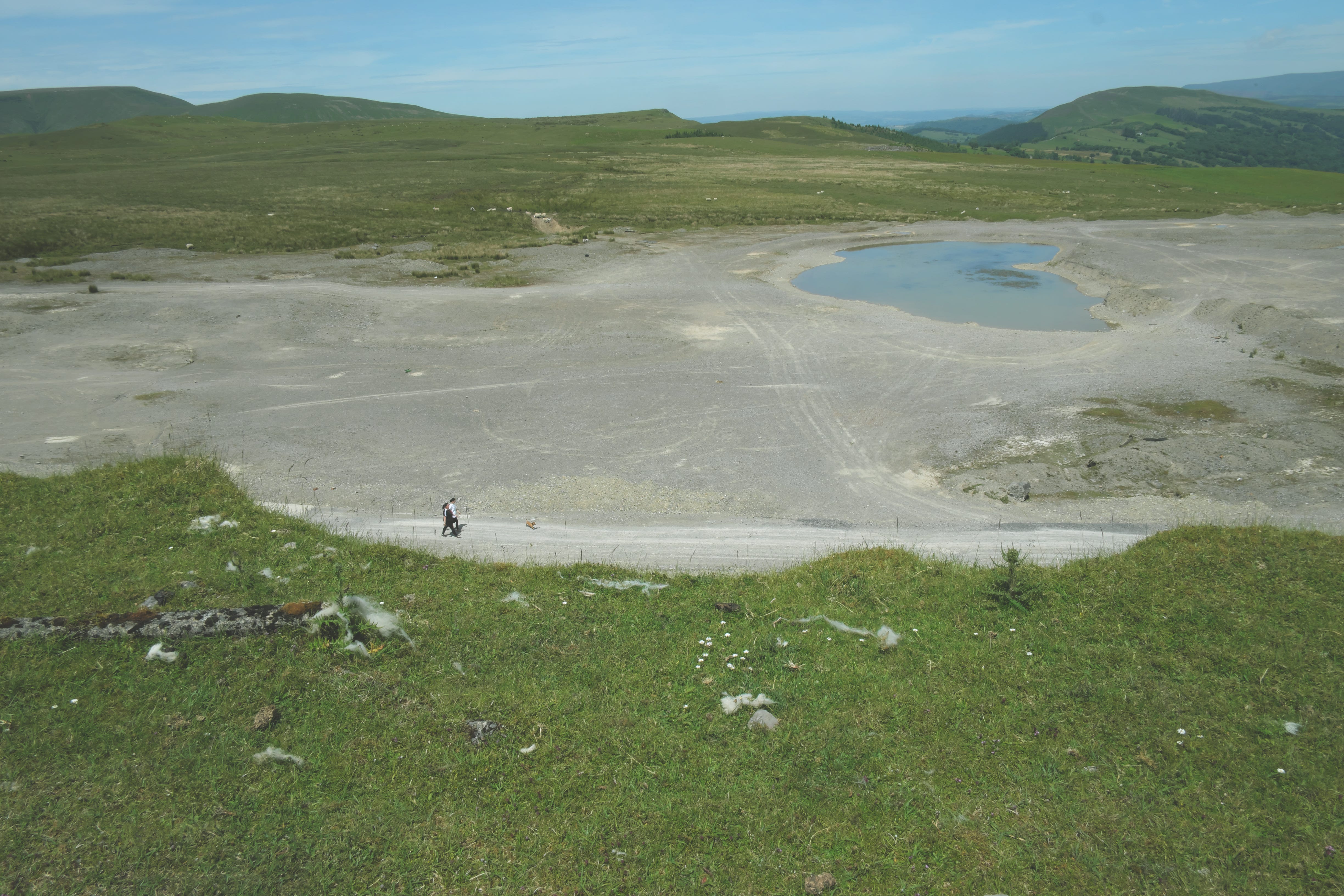
Photography, understood as a critical methodology, can work through these contradictions by turning up evidence of capital’s passage through history. The historical landscape thus becomes a site where absence, loss, and lack are most visible, and where the spectacle of the present is stripped to its empirical rawness. This is not nostalgia, but an inquiry into the enduring human dimensions of social practice and value that persist even when they appear only as traces. Raymond Williams captures this precisely when he writes:
[R]esidual meanings and practices … are the results of earlier social formations, in which certain real meanings and values were generated. In the subsequent default of a particular phase of a dominant culture, there is then a reaching back to those meanings and values which were created in real societies in the past, and which still seem to have some significance because they represent areas of human experience, aspiration and achievement, which the dominant culture under-values or opposes, or even cannot recognise … I would say that we can recognize them on the basis of this proposition: that no mode of production, and therefore no dominant society or order of society, and therefore no dominant culture, in reality exhausts the full range of human practice, human energy, human intention. [3]
For Williams, such residual practices, often tacit and pragmatic, survive in the margins and interstices of the spectacle. In Adorno’s terms, these are forms whose essential meaning can still be secured, if only as potential for the future. Photography can participate in this redemptive work by revealing how capital dismantles one structure of feeling while laying the material ground for the next.
An assembled form of photography, the photobook, for instance, makes this dialectic tangible: bringing dominant, emergent, and residual modes of experience into constellation. In ex-industrial regions, where signs of communal cohesion, the social club, the pub, the factory, have largely vanished; their absence itself becomes a form of presence. To photograph what is missing is, in Adorno’s sense, to illuminate what once was true.
Such a strategy avoids nostalgic platitude and instead foregrounds the reality of social transformation. It invites the viewer to question what ‘community’ or ‘sociality’ might mean under contemporary capitalism. How these relations have been co-opted, mythologised, and commodified. Photography, through a dialectical strategy of presenting presence by absence, refuses the tranquillising panorama of the commodity world. A critical image through which the truth of social experience, its contradictions, losses, and possibilities, momentarily appears.
[1] Raymond Williams ‘Base and Superstructure in Marxist Cultural Theory’ in Culture and Materialism (London and New York: Verso 2005), p. 29.